 info@photosint.eu


HYSYTECH is the partner overseeing the scale-up of the PHOTOSINT technology from laboratory to industrial level, ensuring its technical feasibility, process efficiency, and readiness for future demonstration and industrial deployment. In this interview, Dr Mara Arduino and Dr Alexandru Morosanu provided a brief overview of their role in PHOTOSINT and the expected outcomes and challenges from the industrial perspective.
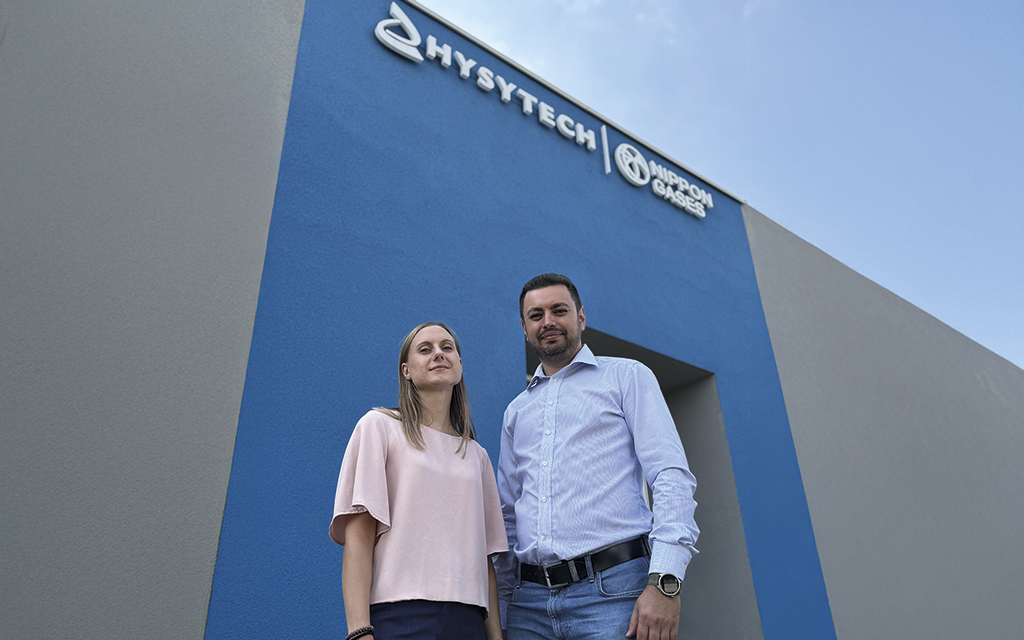
HYSYTECH – part of the NIPPON GASES GROUP - is an Italian engineering company specialised in delivering solutions for gas and energy processes. In this interview, Dr Mara Arduino and Dr Alexandru Morosanu provided a brief overview of PHOTOSINT and its expected outcomes and challenges from the industrial perspective, as well as their role in the project as chemical engineers.
Interviewer (Q): Could you briefly describe the contribution of HYSYTECH to the project?
Mara (M): HYSYTECH role is to bridge the gap between research and industry by integrating the developed PHOTOSINT technologies into real industrial processes. More specifically, our main contribution focuses on the scale-up of the PHOTOSINT technology from laboratory to industrial level, ensuring its technical feasibility, process efficiency, and readiness for future demonstration and industrial deployment. But let’s not forget that the main objective is to replace fossil energy with renewable sources and promote the circular use of local waste resources, contributing to greener and more sustainable production systems.
(Q): Going deeper into PHOTOSINT concepts: in layman's words, what is an electrophotocatalytic cell (ECC) and what is it used for?
(A): An ECC is a device that uses sunlight and electricity for driving chemical reactions, similarly to artificial photosynthesis for the production of chemicals or fuels. In simpler words, the sun partially provides energy for the synthetic processes that can convert CO2 and water into hydrogen and methanol, offering a way to store energy and help reduce carbon emissions.
(Q): Why is HYSYTECH (and the NIPPON GASES GROUP) interested in green hydrogen and biomethanol production?
(M): We are committed to developing sustainable technologies for the energy transition and the production of renewable feedstock chemicals. Green hydrogen and bio-methanol are key enablers of a carbon-neutral economy, as they can directly replace fossil-based fuels and feedstocks in industrial and mobility sectors without requiring major infrastructure changes.
(A): Our current focus is on scaling up efficient and cost-effective production systems that integrate renewable energy, CO₂ valorisation, and circular processes, transforming today’s emissions into tomorrow’s resources. In that sense, PHOTOSINT research represents a great opportunity for innovation testing and evolution.
(Q): How does your expertise in hydrogen gas production/processing and biofuels connect to the project’s goals? And what has been HYSYTECH’s biggest technical achievement in the project so far?
(A): HYSYTECH expertise directly supports PHOTOSINT’s goal of producing renewable fuels from sunlight, water, and CO₂. We focus on integrating the developed photoelectrocatalytic technology into real industrial settings, ensuring it can operate efficiently and safely at scale.
(M): Our biggest technical achievement so far has been the analysis of potential deployment points within industrial processes, identifying where the PHOTOSINT technology can replace fossil energy inputs and maximise its environmental and economic impact. However, we also expect as a main achievement to have a great level of predictability of the impact at the economic and environmental level for the adoption of the PHOTOSINT technologies.
(Q): What makes PHOTOSINT different from other collaborations you have been involved in? And what do you hope the company will gain from being part of PHOTOSINT?
(A): For HYSYTECH, the project offers the opportunity to expand our expertise in photo-electrocatalytic systems and strengthen our role as a bridge between research and industry. It allows us to explore new business opportunities in green hydrogen and CO₂-based fuels, reinforcing our commitment to sustainable industrial technologies. PHOTOSINT stands out because it combines advanced materials research with real industrial integration, linking fundamental science directly to process engineering and deployment. Unlike many low TRL R&D projects, it aims not only to prove a concept but to demonstrate a complete solar-driven fuel production route, from light absorption to product recovery.
(Q): How can the technologies developed in PHOTOSINT generate a real impact in industries like yours?
(M): The technologies developed in PHOTOSINT could enable industries like ours to decarbonise chemical and energy processes by integrating sunlight-driven reactors directly into existing production systems. It is specifically relevant, the possibility to have on-site generation of green hydrogen or renewable methanol using CO₂ and wastewater streams, which can considerably reduce both emissions and feedstock costs. For HYSYTECH, this means the potential to offer new turnkey solutions for industrial clients, combining photo-electrocatalytic conversion units with our established expertise in gas processing, reforming, and biofuel synthesis, paving the way for fully circular, low-carbon plants.
(Q): How do you plan to support the transition from lab-scale photoelectrochemical concepts to industrial-scale processes in PHOTOSINT?
(M): Our commitment is to bridge the gap between laboratory research and industrial application by combining process engineering, mechanical design, and pilot-scale manufacturing within a single integrated approach. In PHOTOSINT, we apply this expertise to translate the TRL4-5 photoelectrocatalytic cell results into an industrial adoption potential analysis, focusing on scalability, safety, operability, and process integration within real industrial settings. From defining technical requirements and materials to designing control systems and evaluating deployment scenarios, we ensure that innovative concepts can evolve into robust, demonstrable, and commercially viable technologies.
(Q): Tell me more about these great challenges of translating highly technical solutions into real-world applications.
(A): There are enormous challenges in translating highly technical laboratory concepts into real-world applications. In PHOTOSINT, for instance, one major difficulty is scaling up photo-electrocatalytic cells while maintaining efficiency, durability, and uniform illumination across larger surfaces. What works perfectly in the lab often behaves very differently at scale; reactions, materials, and components can perform significantly differently when exposed to real industrial conditions. From our experience, additional challenges include material stability, system integration with existing processes, safety compliance, and achieving cost-effectiveness at larger scales. Overcoming these barriers requires close collaboration between researchers, engineers, and industrial partners, which is precisely the strength of projects like PHOTOSINT.
(Q): Being more specific, what are the technical bottlenecks you see in scaling up hydrogen or bio-methanol production?
(A): The main technical bottlenecks in scaling up hydrogen and bio-methanol production are related to efficiency, durability, and system integration. In general, challenges include improving catalyst stability and selectivity, reducing energy consumption, and developing cost-effective reactor designs capable of continuous operation under industrial conditions. For bio-methanol, an additional limitation lies in achieving high CO₂ conversion and effective product purification at moderate pressures and temperatures. In PHOTOSINT, the key challenge is scaling up the photoelectrocatalytic cell while ensuring uniform light distribution, stable operation, and efficient mass transfer over larger active areas. Another critical aspect is the coupling between the photovoltaic (PV) and electrochemical (EC) systems, which requires precise matching between the PV maximum power point and the electrolyser polarisation curve to maximise overall solar-to-fuel efficiency.
(Q): How do you approach the balance between innovation and industrial safety in PHOTOSINT?
(M): In PHOTOSINT, we balance innovation and industrial safety by integrating safety-by-design principles from the earliest stages of engineering. Every new concept is evaluated not only for performance but also for operability, containment, and risk prevention under real operating conditions. For all newly developed processes, we perform hazard and operability analyses, a standard process engineering approach for systematic risk identification and mitigation.
(A): At HYSYTECH, we combine our extensive experience in process design, Pressure Equipment Directive (PED) and ATmosphères EXplosibles (ATEX) directive and pilot plant construction to ensure that innovative systems can be safely built, tested, and scaled. This approach enables us to push technological boundaries while maintaining the highest standards of reliability and safety required in industrial environments.
(Q): In a nutshell, what performance indicators are you tracking to evaluate whether PHOTOSINT’s pilot systems are successful?
(M): We evaluate PHOTOSINT’s pilot systems through a combination of technical, efficiency, and integration indicators. Key parameters include conversion efficiency to hydrogen and methanol, solar energy to fuel efficiency, overall electrical energy consumption, stability and durability of system components, control and maintenance under operational conditions, integration potential of the system and replacement or complementation of existing fossil-based energy inputs.
(Q): How do you envision HYSYTECH’s technologies being adopted in real industrial contexts after the project ends?
(A): After PHOTOSINT, the technology will reach a TRL 4–5, meaning it will be validated at laboratory and prototype scale. The next step will be to advance it toward TRL 7, demonstrating its performance in a relevant industrial environment.
(M): HYSYTECH aims to play a key role in this phase by acting as a technology integrator and industrial partner in future projects. We plan to build on the results of PHOTOSINT to develop a pilot-scale demonstrator, bringing the photoelectrocatalytic process closer to market deployment and evaluating its technical, economic, and environmental feasibility in real industrial applications.
Interviewer (Q): what is that attracts HYSYTECH to collaborate with European and international partners in projects like PHOTOSINT?
(A): Of course, the opportunity to collaborate with leading European and international experts across different disciplines, materials science, photo-electrochemistry, and process engineering, toward a shared goal of sustainable fuel production. This diversity of expertise fosters innovation and practical solutions that no single organisation could achieve alone. It also allows HYSYTECH to bring industrial perspectives early into research, accelerating the translation of breakthrough ideas into real, deployable technologies for a greener future.